Two Months into my London Mission
Setting
I moved to London 2015–03–08. I plan to head back 2015–10–01: just over six months. The Visa is good for a year, but as much as I like it here this wasn’t about leaving home. I’m here on a mission. But this is a document for public consumption, so there’s a limit to how much I’ll talk about the details of that mission.
The City of London
I started out in temporary housing, good for a month, near Monument Station in the City of London.
London is a large number of small villages that grew together into a megalopolis. One of them was called the City of London, which was co-terminous with the original Roman fort of Londinium. One of the weirdest terminology points to get used to is that the City of London and London are very different things; the City of London is this little tiny area, population 11000, and London is this huge area, population infinity. When people say “the City,” they don’t mean London (the big one), they mean the City of London (the little one). To the naked eye, it appears that the City of London is part of London, but there are apparently a bunch of ways in which it retains some autonomy, dating back to when William the Conqueror conquered everything except the Roman fort, which bribed him to leave them alone.
The City of London is all about money and less about people, so it clears out over the weekends, and it is hard to find places to eat. Weirdly, two of the places I found to eat on the weekends in the City were very high, as in above the 30th floors in giant buildings with glass elevators facing out over the city. Later research indicated I’d eaten at two of the four highest restaurants in London, all four of which are in the City of London. Several weeks later, I tried with friends to go to one of the remaining two, but we were turned away at the door due to our insufficiently respectful shoes.
It was in this temporary housing in the City of London that I discovered how terrible washer/dryers are. A washer/dryer is a single implement that both washes and then dries your clothes. If you’re not English, you are probably thinking: that couldn’t possibly work. And you’d be right. The washer gets your clothes wet, and then you have to dry them for like 10 hours. If you put more than about two days worth of clothes in the machine, the dryer is overwhelmed and just cooks your clothes, so that if you open it after several hours of “drying” you’ll find that the clothes are completely full of boiling-hot water. And once, to punish me for who knows what sin, I opened the dryer (which clearly said it was done), and a gallon of hot water poured out on the floor.
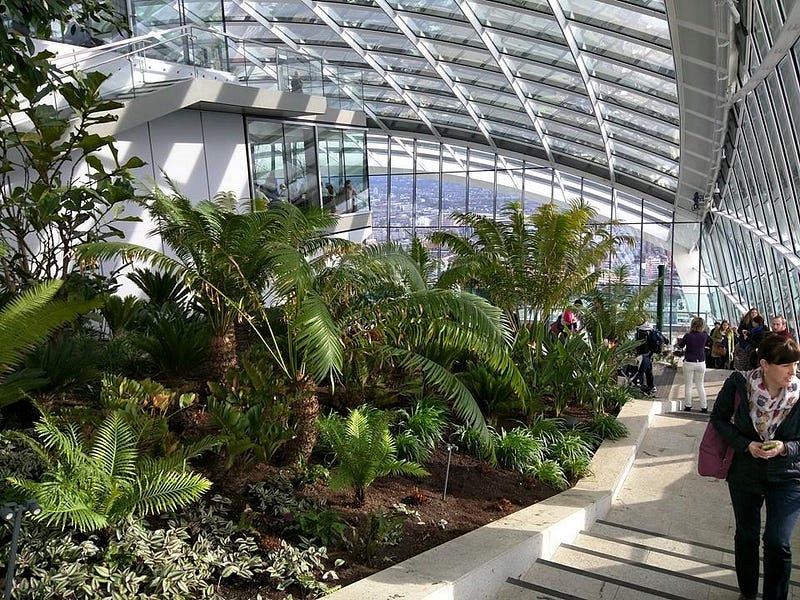
Gloucester Road
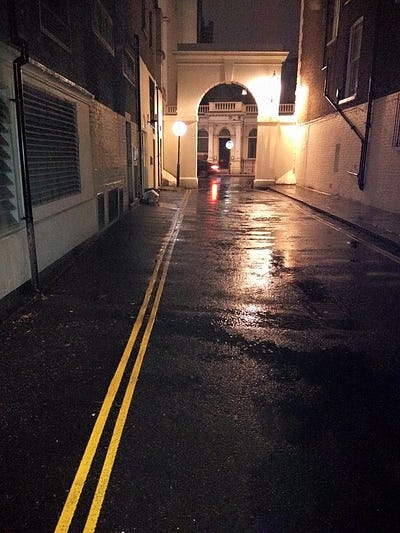
I’m living in Kensington, near Gloucester Road Station. (“Gloucester” is pronounced like “Glaw-ster.” The “-cester” suffix in general is pronounced as “-ster,” and then they just roll some dice to pick the preceding vowel: e.g. “Leicester” is pronounced “Lester.”) Kensington was one of those small villages that amalgamated. I found it with the help of the relocations company; what I told them was I wanted a logical commute to work (it’s three stations away on the Circle/District line), and lots of restaurants in walking distance that weren’t closed on the weekend.
It’s a little house on a Mews, which is a British term for the line of buildings behind the the big houses where the servants used to live; most of the servants quarters (including this one) have been torn down and rebuilt, leaving a house that’s near but not directly on a larger street. The big houses directly on the street, on the other hand, have mostly turned into storefronts.
The washer and dryer are separate, and the dryer is able to dry. That’s good. Less good: the bathroom door doesn’t latch. Looks like it was intended to, it just doesn’t. So when I’m sitting on the toilet, the cat will sometimes come in and want to hang out, which is not my favorite.

I’m writing this from Kensington Gardens, a large public park just a little north of my place, which adjoins Hyde Park, an even bigger park. They’re very well-groomed, but nice and green and full of trees and swans and statues of queens and devils and people staring into the sky with holes in their heads.

The cat
My cat, Oliver Cromwell, settled in better than I’d expected. After some initial sullenness he explored and came to terms with the fact that his environment was arbitrarily different for no reason. He’s an indoor cat, so he hasn’t had to deal with people driving on the wrong side of the road or having strange accents.
Restaurants
There’s been a lot of money in London for a very long time. One thing I noticed early on is that although there are a lot of very good restaurants here, you can’t usually tell by looking whether the food will actually be good; substance is decoupled from style. It’s not that all places that look good have mediocre food; not at all. It’s just that it seems more common than in San Francisco, and you have to do a bit more research.
Every Tuesday I go to a Sichuan restaurant called Bar Shu. It has three sister restaurants: Ba Shan is Sichuan and Hunan, Baozi Inn has dumplings and bao, which I suppose you could call a dumpling, and Baiwei has Sichuan street food. They’re all in Chinatown, near Leicester Square Station, which also has at least one other excellent Sichuan restaurant called Er Mei. I’m trying to find the best ramen restaurant in London, but so far the contenders are weak. We ate at a good Peruvian restaurant last night called Sabor Peruano; it’s been years since I had huancaína and it made me really happy. There is a famous English cuisine restaurant called St. John that does interesting things with unusual cuts of meat, which I have been to in the past but haven’t booked yet on this trip. Lots of other places. Meat pies. French dip sandwiches. Bibimbap.
English Anthropology
I read a book when I got here called Watching the English , by Kate Fox: an English anthropologist applying anthropological methods to the English. One thing she said: the English consider good food a privilege, not a right. I differ with them on that point.
It’s great. She studies what English people do when someone cuts in line (“jumps a queue”): they complain, but only to one another, not to the person who violated social norms. This is the standard method for dealing with most violations.
She tests the hypothesis that if you bump into an English person on the street, that person will apologize to you; in order to make herself do this she had to drink a little first, because it was so difficult to get over her own Englishness. She found if you crash into the English, they will apologize to you; if you crash into continental Europeans, they will ask if you are all right; and as much as you try you will not be able to crash into the Japanese.
She finds numerous similaries between the English and the Japanese, including a focus on “negative politeness,” that is, showing politeness by staying out of people’s way, not talking to people, etc.; as opposed to the “positive politeness” characteristic of e.g. southern Europe, which involves much more convivial speaking to strangers, hugging people at every opportunity, etc.
Google London
The office building I’m working in, Belgrave House (on a street that’s actually called Buckingham Palace Road, near another Google office, whose actual address is 123 Buckingham Palace Road) is laid out in a way I think is perceptive: it recognizes that you need different levels of interaction and interruption at different times, and provides different environments that you can easily move between. The official seating positions are in an open area — adjustable tables with no barriers between you and your coworkers. If a conversation starts, it can pull in the whole team. If it shouldn’t, you can walk a bit further to one of a bunch of unbookable conference rooms with heavy cloth doors called “flight pods,” and continue the discussion in there, with whiteboards and soundproofing. And if you want to focus and get something done, there’s a quiet room called the Cog, with bookshelves, dim lighting and comfortable couches and sitting nooks, where it is anathema to speak. People enter the room, find a seat, and sit down and work quietly in a perfect “negative politeness” bubble of silently socially enforced privacy.
Recognizing that the same person may need different levels of social interaction for different kinds of work and making different environments available seems a lot more intelligent to me than the common argument between open work environment, cubicles, and private offices: no single solution is enough. You need to be able to switch during the day.
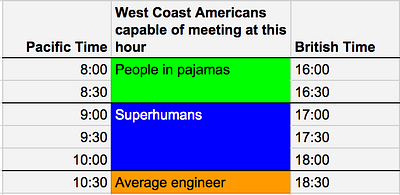
In California, my calendar is completely full of meetings, and this is sort of a necessary evil because the meetings are where we make decisions, and the only opportunity I have to talk to certain people. But in London, because this is a temporary engagement, I’ve been able to pare back my meeting schedule; my 16:00–19:00 hours Monday through Thursday are booked solid, because that’s 08:00–11:00 in California; the limited mutually agreeable meeting time window. (In fact, your average Californian will not be eager to meet before 10:30; a rare breed can meet as early as 09:00, and the people who can do it at 08:00 are usually doing so from home before they’ve commuted in.) At 19:00, I leave for dinner.
But that leaves several hours in the morning and early afternoon for me to actually focus on things and get stuff done. That’s probably going to be the hardest thing to give up when I go back to San Francisco.
The cafes are not terrific here. (It is traditional at Google to complain about the free food.) There are two cafes in Belgrave House, and two more in 123 Buckingham Palace Road. The food is uniformly better in 123, but some sort of bizarre culture has developed in the London office where people think crossing the road is a lot of work. I have explained that if you don’t eat well you’re not really living, and that in Mountain View we regularly bike a mile to get to a better cafe at lunch, but this makes no sense to people who would cheerfully eat food pills from a dispenser if science made that available.
Morning routine
Usually in the mornings I check out a Boris Bike (bikes you can check out with a credit card, called Boris after the mayor, but actually named Barclay/Santander Cycle Hire, after whichever bank is currently sponsoring them) and bike to Belgrave House. You can check the bikes in anywhere in the city, so despite the fact that the bikes themselves are terrible, it has a lot of convenience over owning a bike, which you would have to find a place to lock up. There are no bike lanes — well, there are through the parks, but the parks are not between home and the office — and the streets aren’t laid out in anything resembling a grid, but it’s fine once you get the hang of it. The cars seem more aware of bikes than in San Francisco and there are lots on the road.
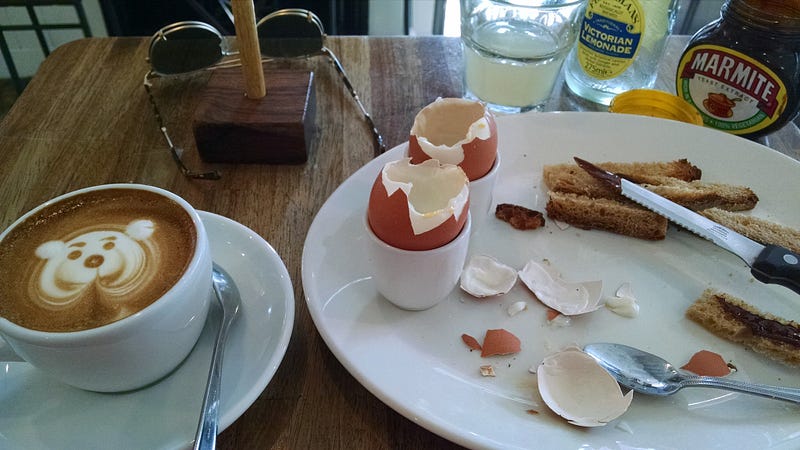
I eat breakfast at a cafe around the corner from the office called Tom Tom Mess Hall, where I order soft boiled eggs stood up in egg cups, and slice off their tops with a spoon and eat their insides with narrow-cut toast called “toast soldiers.” It’s also one of the few places with decent espresso; coffee is one thing London’s not as good at as San Francisco; obviously more cultural focus has gone into tea.
Less successful things
Things I haven’t yet done: set up internet at home. It is super-irritating to only have internet through a cell phone at home, but apparently not enough that I’m willing to try to sign up for internet using that cell phone. (Side note: just saw my phone bill. The urgency of finding a better system has just gone way up.) And when I’m in the office where networking is plentiful, I usually have other things to think about. I also haven’t yet gone off to look at the nooks and crannies of Europe on my own. Maybe Prague, or Lisbon? Definitely want to go to Scotland and Wales again. Maybe the Orkneys.
I’ve flown to Dublin and Zürich on work visits, and back to San Francisco for a wedding, but those don’t count.